
Posted on Facebook on March 10, 2026
Not entirely coherent, a bit personal, maybe even a little pessimistic.
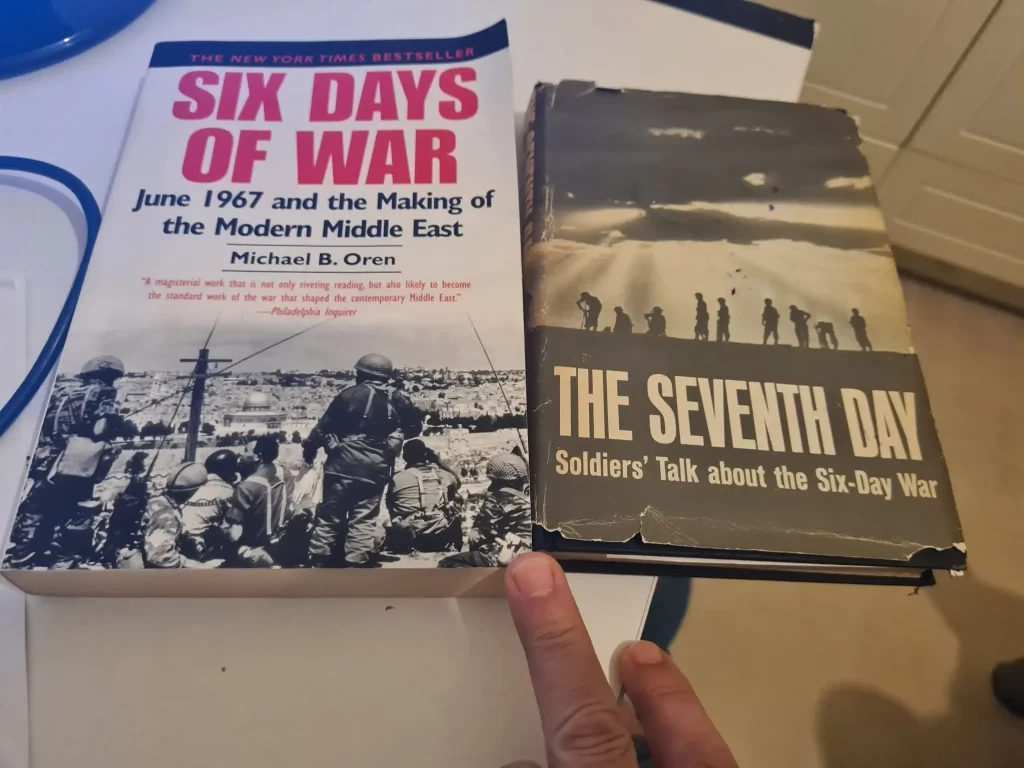
In the past few days, for some reason, two books on my shelf have been pulling my attention, both about the Six-Day War.
“HaYom She’Acharei” – The Day After
“The day after.” In Israel, this phrase carries many meanings. The most familiar expression is “Acharei HaChagim”, literally after the holidays. In practice, it means postponing plans, decisions, and actions until the holidays are over. Unless something is truly urgent, truly life-and-death important, it can wait.
Lately, that is how I feel about much of what is happening around us. It sometimes seems that everything in Israel should simply be put on hold until the war is over.
There is a relentless effort to keep the country running. Yesterday the entire country was buzzing as the Ministry of Education debated bringing children back to in-person learning. There is discussion about returning people, even those in nonessential jobs, to work. Meanwhile, northern communities that remain within the line of fire have still not been evacuated. All of this appears to be an attempt to project normalcy and to minimize the long-term economic and social consequences of the war.
Personally, it makes me angry.
An advertisement on Israeli television for a job-search website confidently declares that the economy is not at a halt. Never mind that parents whose children’s schools are closed cannot go to work even if they want to. Never mind that in many parts of Israel people are still running to shelters several times a day.
But let me make this personal.
The tourism industry is essentially shut down, and it will likely be one of the last sectors to recover, once again. Many of us tour guides had only just begun returning to work. Our calendars were finally starting to look hopeful. It seemed that we might begin to make up for some of the losses of the past years. And now everything has been cancelled.
We are only one sector of the Israeli economy, but it is my sector.
So when an advertisement declares that the market is not at a halt, it is speaking about an economy that simply does not see my entire profession, and, believe me, many others as well.
And it is right there in our faces, on prime-time television.
But let’s step back for a moment and talk about something Israelis have been discussing constantly since the war began: “HaYom She’Acharei”, the day after.
Yes, the day after the war with Iran and Hezbollah in Lebanon, Israel will likely be in a far stronger security position than it was before. Tactically, the hostile forces surrounding us will possess far fewer capabilities to threaten us, regardless of the exact strategic objectives ultimately achieved. The people of Israel, and indeed the people of the region well be safer.
But we must be wary of something else that often follows great victories: the euphoria and the hubris of the day after.
Those emotions can carry consequences, both within Israeli society and in Israel’s relationship with the wider world.
In a previous post, drawing on the ideas of Micah Goodman in his book The Eighth Day: Israel After October 7, I wrote that On October 7th, we, the fourth generation of Israelis, were given a wake-up call that reminded us that the state of Israel is not a given factor, and that we should not take it for granted. We were given the perspective of the first generation, the generation who knew a state of Jewish Galut and knew a state of Jewish statehood. (https://zalman-israelguide.com/yom-hashoah-yom…/…)
In a certain sense, October 7 was our generation’s War of Independence.
Since that day, Israel has achieved significant tactical and strategic successes across multiple fronts. We entered this war with determination and with a deep sense of justice.
In some ways, the moment invites comparison to the Six-Day War of 1967. Israel, still a young state only nineteen years old, faced enemies who openly declared their intention to destroy it. Israel launched a pre-emptive strike that led to a dramatic six-day victory, reshaping its place in the region, in the world, and in Jewish history. The ethos that emerged was powerful: a just war, the few against the many, the weak against the strong.
But when we think about the day after, we must also remember what followed that victory.
The euphoria after the June 1967 war was unprecedented. It replaced the deep existential anxiety of the weeks before the war, the tense period Israelis remember as the “waiting period.” The stunning victory produced an immense surge of confidence: faith in the strength of the Israel Defense Forces, pride in the country’s leadership, and a renewed emotional connection to historic and biblical sites such as Jerusalem, the Western Wall, and Hebron.
Israeli society moved almost overnight from fear of a “second Holocaust” to a profound sense of strength and triumph. The capture of the Old City and the Western Wall became a powerful national and emotional moment, inspiring both religious and secular Israelis alike. The return to regions associated with the Bible: Judea, Samaria, Sinai, and the Golan Heights, reinforced a deep historical consciousness. The IDF was widely viewed as nearly invincible, and admiration for military commanders became widespread. Israeli culture reflected this spirit of triumph. Songs, books, and newspapers captured the patriotic enthusiasm and emotional intensity of the victory.
But that confidence gradually hardened into something else.
The sense of overwhelming superiority eventually became known as “the Conceptzia” the strategic assumption that Israel’s enemies would not dare launch a war they could not win. The optimism began to erode during the War of Attrition (1967–1970), but the true shock came in the surprise attack of the Yom Kippur War in 1973.
And that is why I fear the day after.
Do not misunderstand me. I am glad to see the weakening and elimination of the hostile powers around us. But I worry about the dangers that may grow from within.
For more than two and a half years now, we have been living through this war. It has been a long struggle, one that has brought both remarkable achievements and deep exhaustion.
On October 6, 2023, we were already a deeply divided society. Those divisions have not disappeared. We still have much healing to do.
We also have leadership that failed us on October 7, and that now risks building a sense of national hubris based solely on military achievements since that day.
I worry about what that could mean for our society when the war finally ends.
I am not a prophet, nor do I pretend to offer political or strategic predictions. But when I look back at one of Israel’s greatest victories, the Six-Day War, I feel the urge to call out to our leaders: think about the day after!
Meanwhile, I am simply another very tired citizen. This war has taken me for a difficult ride. Once again I find myself wondering whether I should change professions and look for the stability of a regular paycheck.
But then I remember that the place where I feel happiest is with my people, in my land and in my state, sharing it with others. I look forward for that day after.