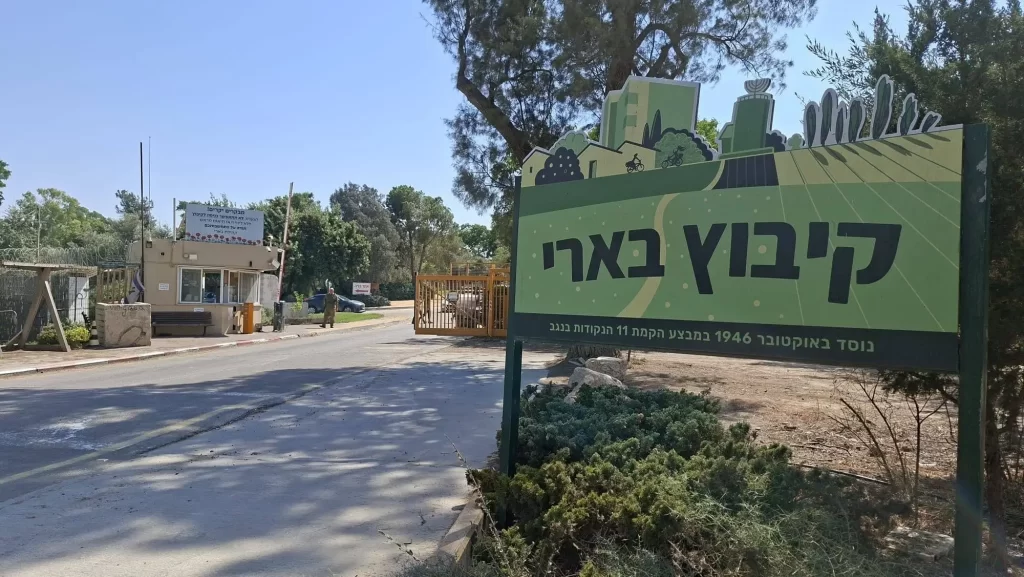
As Another Reserve Duty Assignment Comes to an End – This Time in Kibbutz Be’eri
Reserve duty is usually a straightforward military mission: guarding a border, manning an outpost, operating in a combat zone, or carrying out an operational assignment. But in Be’eri, the military mission takes place within a civilian community—a community striving to rebuild its life after the massacre of October 7. It is a mission that is as meaningful as it is challenging
These are not reserve duties on the front lines of the fighting. Not beyond the security fence in the combat zones, not across the border in Syria or Lebanon, and not in Judea and Samaria between Areas A, B, and C. This is reserve duty in a civilian setting, inside a thriving kibbutz in the heart of the State of Israel. Since October 7, defending a community like this has itself become a military mission. As long as this remains our reality, I am grateful to serve and to carry out that mission to the best of my ability.
I often tell my soldiers that as long as this is a military mission, if we are not here to do it, then the regular soldiers of the 202nd Paratroopers Battalion stationed at the Nahal Oz outpost, or whichever unit replaces them, or any other force operating in the sector, will have to divert personnel from their primary operational tasks to carry it out. As long as we are here, allowing them to focus on their combat responsibilities, we are making an important contribution.
There are still kibbutzim evacuated after the October 7 massacre whose residents have yet to return. Personal and communal healing still lies ahead, alongside the enormous physical task of rebuilding the communities themselves, both private homes and shared public and communal spaces. Only once the kibbutz is truly ready can its members return and begin rebuilding community life.
Our presence in the kibbutz serves many purposes. First and foremost, we function as the immediate response force for any security incident that may occur. That is why we live inside the kibbutz. In close cooperation with the community’s security coordinator and the local security teams, we are responsible for its day-to-day security.
In Be’eri, for example, hundreds of workers enter the community every day, both to support its agricultural and economic activities and to carry out the demolition, cleanup, and reconstruction of areas devastated on October 7. At the same time, we are involved in strengthening the community’s defenses and preparing it for a more secure future.
Beyond the practical mission, there is another purpose to our presence.
October 7 exposed a profound systemic failure in the IDF’s ability to deter, warn, respond, and ultimately protect the residents of the Gaza border communities. This observation does not diminish, even for a moment, the extraordinary courage of the soldiers who fought that day, those already stationed in the area and those who rushed there from elsewhere. They fought like lions, shielding Israeli civilians with their own bodies, and many paid with their lives.
Yet on an institutional level, the failure deeply damaged public trust in the security establishment and in its ability to fulfill its most fundamental responsibility.
In some measure, our presence inside these communities since October 7 is also meant to rebuild that trust, to be seen, to be present, and to remind residents that the army has not abandoned them.
Yet our presence carries its own complexity.
For many residents, the sight of soldiers walking through the kibbutz, or running drills in helmets, body armor, and rifles, is itself a trigger. The last time they saw soldiers running between these homes, it was during the worst day of their lives. It was a scene of terror, life and death. It was trauma.
During my time in Be’eri, I met many members of the community. Some I encountered almost daily, others during visits back to the kibbutz. I made a point of walking through its neighborhoods, green lawns, pathways, and beautiful homes, stopping whenever possible to speak with residents.
One question I found myself asking over and over again was:
“How do you feel about soldiers living inside the kibbutz?”
I should begin by saying that every single person expressed gratitude. At no point did I feel unwelcome. Quite the opposite.
Yet two very different conversations captured the complexity of the situation.
At a wedding held in the kibbutz, I met a woman whose husband had been murdered on October 7. It was a difficult conversation. After thanking us for being there, she said:
“I’m not coming back unless there are soldiers permanently stationed here. For years we took care of the soldiers. They passed through this area after leaving Gaza, we hosted them, fed them, looked after them. Now it’s time for the army to take care of us.”
The IDF is the people’s army. Its purpose is to safeguard the continued existence and flourishing of the State of Israel and its citizens. I have immense respect for those who chose to build their lives in communities like these, and her words resonated deeply with me.
Another conversation took place with all of our soldiers and a kibbutz member responsible for security. The very same question came up, but the answer was entirely different.
After expressing appreciation for our work and acknowledging the importance of our presence at this particular moment, he argued that the long-term presence of the army inside the kibbutz is itself a problem, not only for Be’eri, but conceptually for the State of Israel.
In his view, and I agree with him in many ways, Be’eri, like every other kibbutz, moshav, and town along the Gaza border, is an ordinary Israeli community. The army is meant to defend the country’s borders, not to be permanently stationed inside civilian neighborhoods. If a criminal or internal security incident occurs, it should be handled by the police.
A permanent military presence transforms the kibbutz into a frontline military outpost. It gives it the status of an exceptional community, comparable to certain settlements in Judea and Samaria or military positions inside buffer zones beyond Israel’s borders in Gaza, Syria, or Lebanon.
That is not a reality a sovereign state can accept indefinitely.
The state and the army must restore security at the border itself, ensuring that every threat can be addressed without requiring soldiers to live inside civilian communities. Until that day comes, however, our presence remains both necessary and justified.
I find truth in both perspectives.
I have written before about the importance of bringing residents back to their homes, both in the Gaza border region and along Israel’s northern frontier. It is a matter of simple justice that those who lost the security of their homes should be able to return, rebuild, and once again live lives of dignity, prosperity, and peace.
But it is also something larger.
The return of these communities must be accompanied not only by a feeling of security, but by genuine personal safety. At the same time, we must send a clear message: these are not “frontier communities” or “problematic communities.” They are an inseparable part of the State of Israel, equal in every respect to every other community in the country.
I hope that the time I spent serving in the Gaza border region contributed, even in some small way, not only to strengthening its security but also to affirming a simple truth: this is an integral part of the Land and the State of Israel, a place of life, community, and hope, deserving of the same commitment and care as every other place in our country.
When I left Be’eri, I carried with me the same question that had accompanied me throughout my service.
I want the residents of Be’eri to feel secure enough to know that we are here for them, for as long as they need us.
But even more than that, I pray for the day when they will no longer need us.
Not because we care any less.
Not because the threats will disappear.
But because the State of Israel will once again be what it is meant to be: a country whose army defends its borders, not one whose soldiers must live between the homes and children’s playgrounds of its communities.
A country where Kibbutz Be’eri is not a frontline military outpost.
But simply a home.